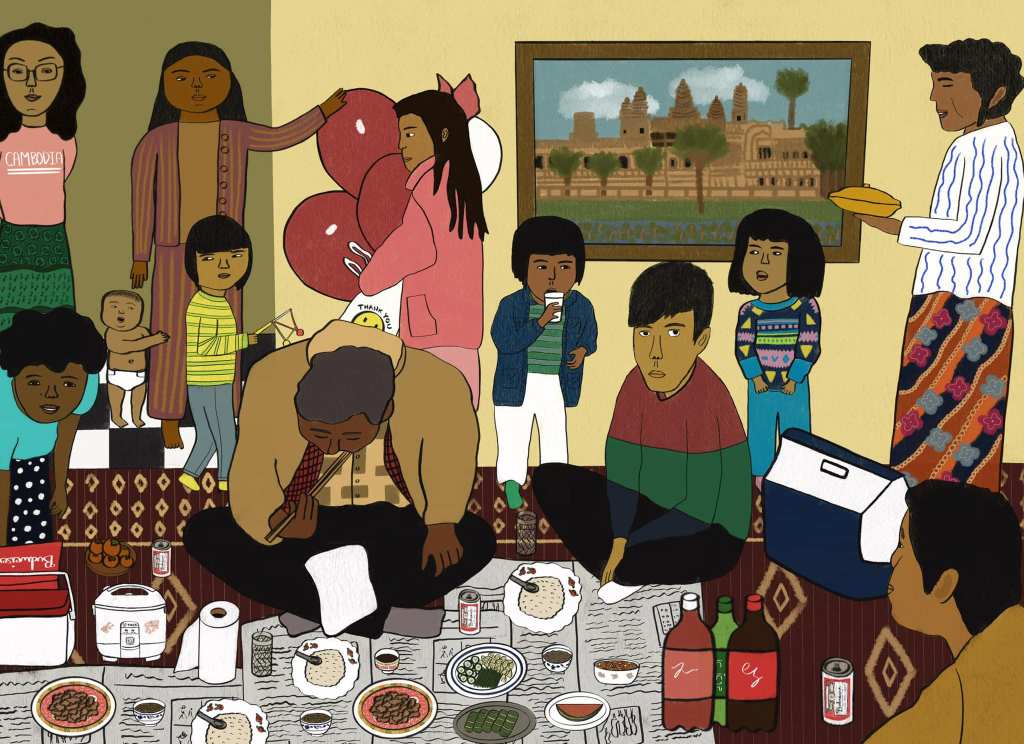
“Celebration,” digital illustration using Procreate, 2022.
Procreate brushes: Gesinski (inking), Melaleuca (textures)
Total time (approx): around 40 hours at least, over the course of 1 month/1.5 months
BACKGROUND
Most of my inspiration for drawing comes from witnessing ordinary people in my day-to-day life and on my social media feed. These people are “ordinary” in the sense that most of the people I draw are not famous. They are family, friends, coworkers, acquaintances. But I think there is something so extraordinary about humans who lead unassuming lives in and around my social circles, speckles of well-meaning flesh in my periphery. I, too, am a bag of well-meaning flesh trying to do my best and get through the day. I want to evoke that in my art. When I draw people, it feels intimate, even when I am not face-to-face with them but simply looking at a photograph as a reference. I almost feel like I know them a little more, as I draw lines to form the specific shape of their mouth, or their hair, or their hands.
Some time ago, I was visiting my mother and was flipping through some old photo albums. I came across a picture of what looked like a family gathering of some kind. I vaguely recalled it might have been someone’s birthday–perhaps mine, when I was a small child. I wasn’t featured in the photo, but judging by the setting, it looked like the living room of the apartment we lived in up until I was about five. There were multiple people of various ages in the picture, all caught in varying poses. Some were sitting down and eating; others were crowding the background. I spied my mom on the far left, wearing a polka-dotted dress, her hair in a short perm, reaching her hand down to grab a drink from a box. I spied my teenage cousin in the backdrop, dressed in all pink, carrying party balloons. The photo was a bit chaotic, and yet, through the chaos, there was an overwhelming sense of nostalgia, familiarity, comfort, and home. Whoever took this photo (perhaps my father) had unintentionally captured what I felt was a quintessentially Khmer moment in time: the 90s hairstyles and fits, the feast spread out on the floor, the pretty patterned kantael peeking out underneath, the cans of Budweiser, the liters of off-brand soda, the Tiger rice cooker with the flowers printed on the side, the distinctively Asian dishware with abstract and floral designs that you could buy at any Asian mom-and-pop shop near you, the plate of persimmons hiding in plain sight. I snapped a picture of this picture and favorited it on my phone. I knew I needed to draw it, and I knew it would take a long time.
These people were speckles of well-meaning flesh in my periphery, trapped in shades of time and place that spoke to me. I wanted to wait until I had the skill and experience to capture what it made me feel.
PROCESS
It took me 2 years before I mustered the nerve to try recreating the photo according to my own artistic interpretation. It didn’t need to be an exact replica, I decided, as long as it felt emotionally true to the essence of the picture. I started out very slowly, deciding to focus on illustrating one person at a time in the photo, then go from there. The first person I sketched out was the woman on the far right, a Ming (but likely not blood-related) I remember seeing sometimes when we were kids, before my father died and before we stopped going to church. In the photo, she wears a plain white long-sleeve shirt and carries a plain white dish in her hands. The blandness bothered me. I decided to embellish the details; I made the dish a golden yellow and added wavy blue lines to her blouse. It felt right to take some creative license, for some reason. In some ways I felt protective of the photo and who was actually in it; changing things made it feel safer to share publicly. And again, there was more of an emotional core I was trying to get to, not a biographical one.
I experienced several stops and starts for every couple of people I managed to draw. The project felt too big of an undertaking at times. There were days, weeks that I went without looking at it. Ironically, it was only when I truly began to take in the progress that I was making (about a third to halfway through) that my pace picked up. Suddenly I was in a rush to complete the drawing, while wanting to be as detailed as possible. The changes I hesitated to make at first were now incorporated without too much emotional handwringing. The color of my male cousin’s sweater. The baby clinging to its mother’s leg. The smiley-face bag my female cousin carried in her other hand (the hand not carrying the aforementioned tangle of balloons). The framed picture of the Angkor Wat temple on the wall. Everyone’s skin tones (I went for darker.) The design of the skirt worn by the woman on the top left in what had become a very crowded, eclectic composition. These details, and more, were all impulsively added or reinvented by me, the artist playing God. I splashed color and added spice to taste. Although the illustration had become a hybrid between fact and fiction, it was, overall and in my eyes, a very good snapshot of something that was emotionally real to me: family, culture, and connection, back in the day when things felt easier but probably weren’t, the “good” ol’ days when we didn’t know what we would lose.
FINAL THOUGHTS
I am proud of the time and effort I put into creating this illustration. I’ve never drawn this many people at once with such a painstaking level of detail, so this was definitely a challenge for me. But I always want to challenge myself in my creative pursuits; otherwise, I would never grow. I am particularly proud of the rice cooker, the tableware, the food, and the baby, as I feel these things are not the easiest to draw. I kind of wish I had squeezed other kinds of food into the foreground, or maybe depicted Cambodian hot pot as the entree; I also kind of wish I could redo the Angkor Wat painting. But as a perfectionist, there’s always going to be something I’ll want to change, so a part of my artistic practice has been blessing and releasing the nitpicking of details and embracing the imperfections–which just so happens to be a good motto for life in general, too.
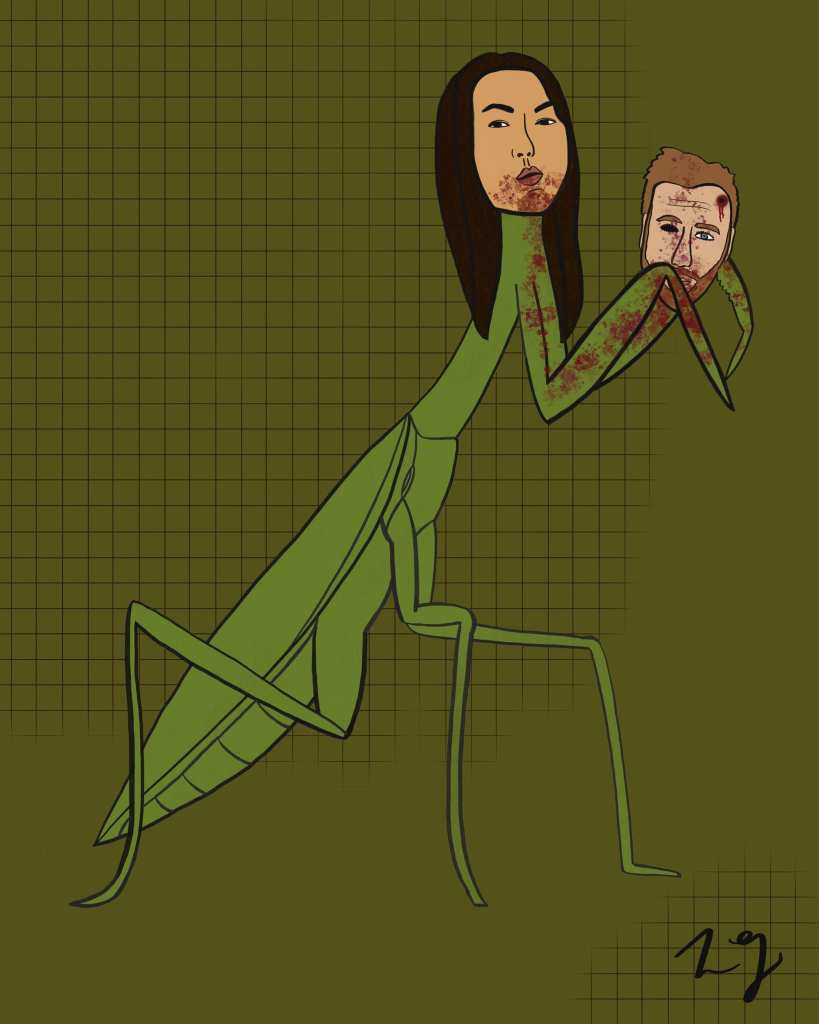
 Art by Learkana